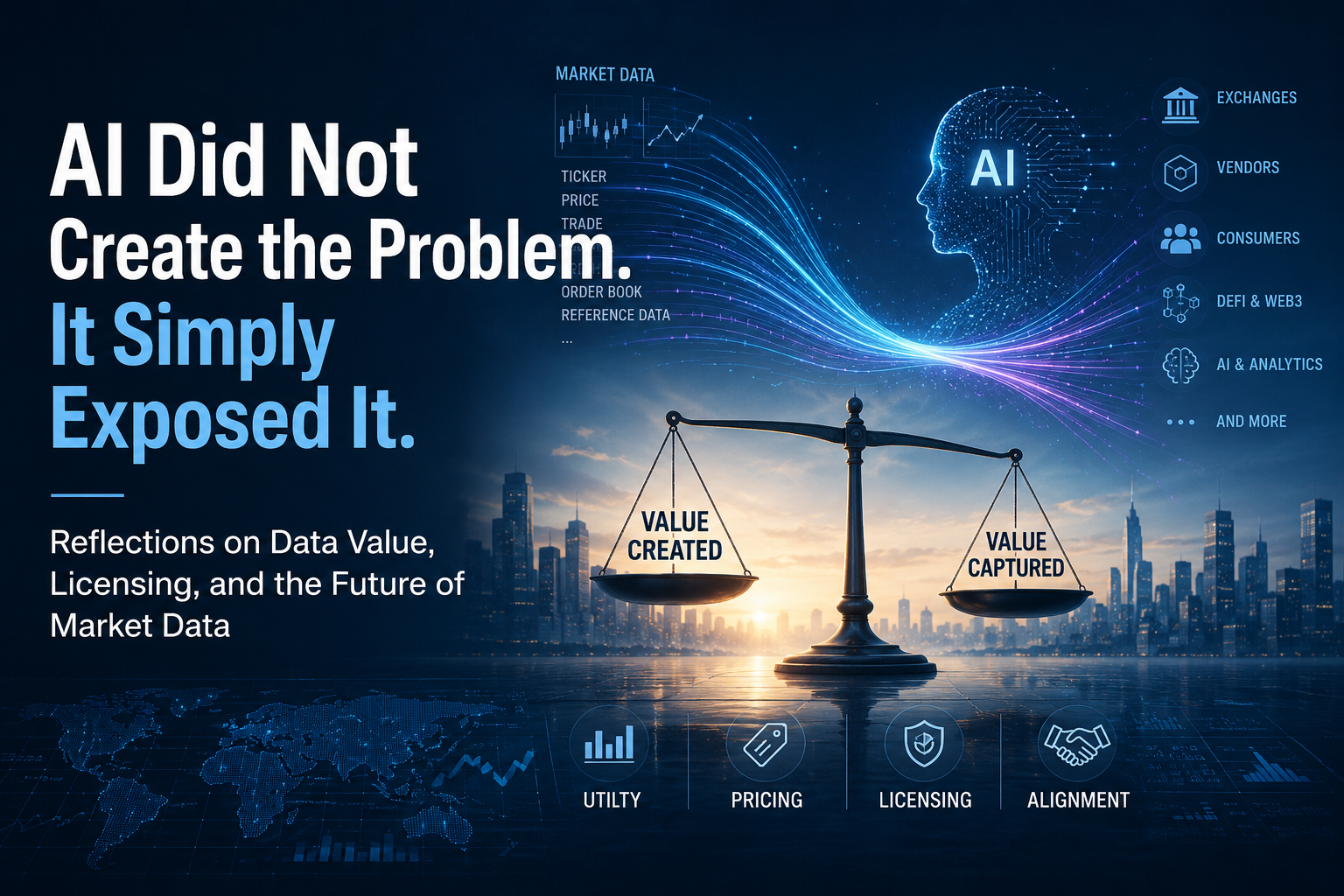
AI Did Not Create the Problem.
It Exposed the Value Question.
Reflections on Data Value, Licensing, and the Future of Market Data
This article reflects my personal observations and thoughts after attending a session at AsiaFIC 2026. It is intended solely as an individual reflection and does not represent the views of any company, organization, or panel participant.
One of the most thought-provoking sessions at AsiaFIC 2026 was From Ticker to Token. While the discussion touched on AI, tokenization, DeFi, and emerging technologies, the central question was far more fundamental:
How should the financial data industry define, measure, and monetize value in an era of rapid technological change?
A Changing Market Data Landscape
A decade ago, the market data ecosystem was relatively straightforward. Exchanges generated data, vendors distributed and enriched it, and most consumers accessed information through vendor terminals.
Today, that structure is rapidly evolving. Cloud infrastructure, APIs, big data technologies, and AI have lowered the barriers to data consumption and distribution. Exchanges increasingly offer direct data services, while vendors continue expanding through acquisitions and new product offerings. The traditional boundaries between data producers and distributors are becoming increasingly blurred.
At the same time, entirely new participants are entering the ecosystem. DeFi platforms, prediction markets, perpetual futures venues, AI-native analytics firms, and data oracle providers are creating new forms of demand for market information. Financial data is no longer consumed exclusively within traditional financial markets; it is becoming a foundational input for a broader digital economy.
AI Has Not Created a New Problem
One of the most interesting insights from the discussion was that AI has not fundamentally created a new challenge for the financial data industry. Rather, it has exposed a challenge that has existed for decades.
At its core, the issue is not AI itself. The issue is how the industry defines and prices the value of data.
Historically, market data licensing frameworks were built around relatively simple consumption models. Most users accessed information through vendor terminals, and user counts, devices, and terminals served as practical proxies for the value extracted from data.
As machine-driven workflows emerged, the industry introduced the concept of Non-Display usage. Importantly, Non-Display was never a precise description of what users were doing with data. It was largely defined by what it was not: any use case that did not involve a human viewing information on a screen.
One could therefore ask whether AI-driven consumption requires an entirely new category of rights. However, AI may be better understood as an extension of machine-based consumption rather than a completely unprecedented form of data usage. Technologies have continuously expanded the ways data can be consumed and monetized, while the underlying purposes—trading, risk management, research, benchmarking, analytics, and decision support—have remained broadly consistent.
From this perspective, many AI use cases may fit naturally within concepts the industry already developed over the past two decades, particularly the broad category of Non-Display usage. The more difficult question is not whether AI can be licensed, but whether existing licensing frameworks remain effective in observing, measuring, and valuing increasingly diverse forms of data consumption.
Today, AI agents, autonomous systems, tokenized markets, and DeFi infrastructures are creating new ways of generating value from data. While many of these activities may technically fall under existing licensing categories, the value they generate can differ dramatically.
AI did not change the underlying question. It simply made that question impossible to ignore.
Beyond Usage-Based Pricing
If AI did not create a new problem, then what exactly is the problem that it exposed?
The discussion repeatedly returned to one answer: value.
For decades, the industry has debated the relationship between the value of data and the price charged for it. Some argue that pricing should remain closely linked to the cost of producing and distributing data. Others emphasize that data derives value not only from production costs but also from the economic benefits it creates for users.
Rather than attempting to measure value directly, the industry developed observable proxies. User counts, terminal counts, Display versus Non-Display classifications, and various usage categories became practical mechanisms for estimating how value might be extracted from data.
The challenge today is that observed usage and actual value creation are becoming increasingly difficult to connect.
A quantitative hedge fund, an AI research platform, a DeFi protocol, a benchmark administrator, and a retail analytics application may all fall under similar licensing classifications while generating vastly different levels of economic value.
This naturally raises a new question: even within existing licensing categories, can pricing become more granular and better aligned with the value that customers create from data?
One particularly interesting idea raised during the discussion was whether the industry may eventually need to look beyond usage itself.
Some participants discussed the hypothetical possibility of linking part of a data provider’s compensation to the outcomes generated through the use of data. Under such a model, if a dataset contributed to significant investment returns, a portion of that value creation could, in theory, flow back to the data provider. Conceptually, this resembles the performance-fee structures commonly found in the investment management industry.
From a pricing perspective, such an approach would not necessarily replace traditional licensing models. Rather, it could be viewed as a potential evolution of the variable-fee component of data pricing, complementing existing access fees and usage-based charges.
At present, this remains largely a conceptual idea. Measuring the contribution of a specific dataset to investment performance is extraordinarily difficult, and any practical implementation would require broad agreement between data producers and data consumers.
Nevertheless, the discussion reflects a broader shift in thinking. For decades, the industry measured users. Then it measured usage. Increasingly, it is beginning to ask whether those measures remain sufficient to represent value creation in a world shaped by AI, automation, and machine-driven decision making.
The Need for a Common Ground
Despite discussions around AI, tokenization, blockchain, and digital assets, the most important takeaway was not technological—it was cultural.
The future of financial data will require a new common ground among market participants.
Data producers need greater visibility into how their data is used. Data consumers need a clearer understanding of why licensing frameworks and intellectual property protections exist. New entrants need to understand the norms and conventions that have shaped the industry for decades.
The more constructive path forward may be to move beyond willful ignorance and instead foster a genuine will to understand.
Because ultimately, the future of financial data will not be determined solely by technology. It will be shaped by whether producers, distributors, consumers, and regulators can develop a shared understanding of how value is created, measured, and fairly distributed.
AI may be accelerating change, but the industry’s central challenge remains remarkably familiar:
How do we align the value created by data with the value captured by those who produce it?
The answer may well define the next chapter of the financial data industry.